
Eureka!
The Day of the Lord in 2 Peter 3

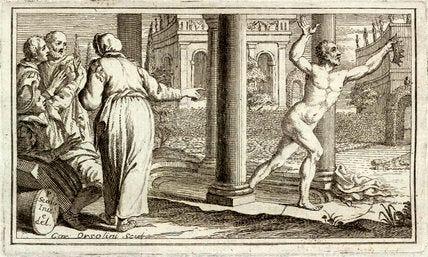
The story goes that when Archimedes discovered the law of physics concerning buoyancy now known as the Archimedes principle whilst taking a bath, he kept from his bath shouting ‘Eureka – I have found it’, and went running naked through the streets of Syracuse.
If you will allow me to get technical for a moment, and maybe pour some cold water on this story, but because of the accent on the diphthong εὕ, Archimedes would have shouted ‘εὕρηκα – heúrēka!’
If you parse εὕρηκα, you find that it is the first-person singular perfect active indicative of εὑρίσκω. And that is a word that has been significant in my own research. The third person singular passive indicative of εὑρίσκω, εὑρεθήσεται, appears in 2 Peter 3.10.

As I explained in an earlier post, verse 10 is a notoriously difficult textual variant because of the word εὑρεθήσεται. The word εὑρεθήσεται appears in the earliest manuscripts we have, but it is a grammatically awkward construct that has morphed into other words by the Byzantine period.
Earlier this year I listened to a podcast of The Pastor’s Heart, where William Taylor was interviewed about his views regarding work and ministry. I’ve interacted with some of Taylor’s previous teaching about work, so I was interested to hear if he was still on message nine years later. My review of Revolutionary Work was my first post on this substack.
At one point the conversation turned to 2 Peter 3, particularly to the issue of 2 Peter 3.10. William Taylor posed the question: does verse 10 describe destruction or a revealing? In contrasting his reading of 2 Peter 3 to Tim Keller’s, William said: ‘I think Tim follows an article actually by Jonathan Moo, who argues very strongly that 2 Peter 3 is about a revealing, a showing, and therefore a revealing of our works, rather than a destruction.’
To be honest with you, I find it hard to follow Taylor’s logic here. I don’t think that judgement and revealing are as diametrically opposed as Taylor makes out. If 2 Peter 3 is about anything, it is about the coming judgement of the Lord on ‘the day of God’. And judgement entails both destruction and disclosure. I think that’s apparent in similar passages to 2 Peter 3, such as Revelation 6. Like 2 Peter 3, Revelation draws on the apocalyptic language to depict cosmic destruction as the stars fall from the sky. As the heavens are rolled up like a scroll, and the mountains and islands are removed, humanity is left with nowhere left to hide:
‘Then the kings of the earth, the princes, the generals, the rich, the mighty, and everyone else, both slave and free, hid in caves and among the rocks of the mountains. They called to the mountains and the rocks, “Fall on us and hide us from the face of him who sits on the throne and from the wrath of the Lamb! For the great day of their wrath has come, and who can withstand it?”’ – Revelation 6.15-17
The point here, much like in 2 Peter 3.10, is that when the Lord returns to judge, there will be no place to hide. Everyone and their deeds will be exposed. The Apostle Paul makes a similar point in 1 Corinthians 4.5: ‘Therefore judge nothing before the appointed time; wait until the Lord comes. He will bring to light what is hidden in darkness and will expose the motives of the heart. At that time each will receive their praise from God.’
The point is that this uncovering is part of God’s judgement. According to the former rector of St Helen’s Bishopsgate in London, Dick Lucas, said in his commentary with Christopher Green, in regards to this question:
“Finally, everything in the earth will be laid bare. That is, everything God has made and done, and everything mankind [sic] has made and done, will be laid open and be on full view to him. God will literally judge the works! Artists and scientists, insignificant and grand, leader and led, Christian and non-Christian, will all be laid bare to God. This is what Jesus had in mind when he described himself as a master who leaves his servants with work to do and then returns to inspect them.”
God’s judgement isn’t mere wanton destruction. It’s both destruction and disclosure, so that the world can be seen for what it truly is. Although Taylor contested the point in the podcast, this unveiling is what makes 2 Peter 3 apocalyptic. The eureka moment of verse 10 is to bring everything to light so that wickedness and sin might be held accountable by God. That’s why we look for a new heavens and a new earth, where righteousness is at home.
